

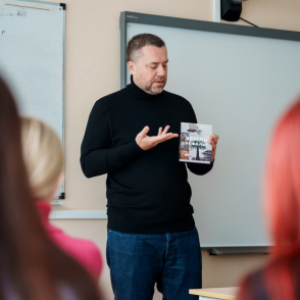
A thought-provoking conversation about literature, journalism, and the search for meaning recently took place at the Faculty of Philology and Journalism.
The guest speaker was Evgeny Dolgikh, an alumnus of the Department of Russian and Foreign Literature, a published writer, and the current Press Secretary of Mosfilm. He candidly admitted to the students that his academic performance during his first two years was lackluster, bringing him to the brink of expulsion, before he finally buckled down and turned his studies around. He emphasized that the university gave him the most crucial skills: the ability to process information, discern what truly matters, and develop a broad worldview—assets that continue to serve him well in both cinema and literature today.
Following his early journalism career at Samara television channels, he relocated to Moscow, working for the Izvestia Media Group, before eventually joining Mosfilm and collaborating with renowned director Karen Shakhnazarov.
In parallel with his media career, he has been actively writing: publishing short stories in Russkoye Ekho (Russian Echo) and other literary magazines, and releasing his book Earth. Asphalt. Furthermore, his novella The Razor is currently in development for a feature film adaptation.
The discussion touched upon the nature of inspiration, with Dolgikh advising not to wait for a muse, but simply to sit down and write. He shared his belief that art is a "transmission of emotion" and that a unique authorial style will always outlast fleeting trends. The conversation also spanned the literary legacies of Sergei Dovlatov and Vasily Shukshin, the state of contemporary prose, the impact of neural networks on writing, and the enduring value of a philological education.
To conclude the event, the author read an ironic short story about a writer who traded traditional rural prose for blogging and internet hype. The meeting ended with a profound reflection on personal ethics: in today's world, it is crucial to define one's own moral compass, but doing so requires continuous learning, extensive reading, and staying true to oneself.
"I highly recommend reading Earth. Asphalt, especially for those who yearn for quality neorealism, authentic literary prose, and genuine, highly recognizable dialogue," recommended Konstantin Pozdnyakov, Doctor of Philological Sciences and Professor at the Department of Russian and Foreign Literature and Public Relations, addressing the students.
